
Carbon Fiber Reinforced Nylon vs Glass Fiber Reinforced Nylon: Comprehensive Performance Comparison
Industrial engineering demands continuous evaluation of lightweight composite materials. As global manufacturing scales up efficiency targets, high-performance Fiber Reinforced Nylon compounds play a crucial role in metal replacement projects. Polymer specifiers face a structural choice between carbon fiber (CF) and glass fiber (GF) reinforcements. While glass fiber has long dominated the market due to its low cost, carbon fiber is rapidly gaining ground in specialized structural applications. This comparative study analyzes the physical, electrical, and economic trade-offs between both filler technologies. Rather than declaring one material universally superior, objective evaluation shows that operational environment dictates the ideal choice.
For decades, glass fiber reinforced polyamides served as the default choice for structural plastic components. The low production cost of E-glass fiber allowed compounding mills to produce high-strength materials at competitive price points. In contrast, carbon fiber precursors required energy-intensive carbonization processes, restricting carbon fiber composites to aerospace and high-end automotive sectors.
However, recent advancements in precursor chemistry and large-tow fiber manufacturing have begun shifting this cost dynamic. The market price of commercial-grade carbon fiber continues a gradual downward trend. Consequently, design engineers now evaluate carbon fiber compounds for mainstream industrial applications where extreme weight savings justify a moderate price premium.
Despite these cost improvements, glass fiber maintains a substantial price advantage. Raw glass fiber remains significantly cheaper per kilogram than carbon fiber. Therefore, complete market substitution will not occur. Instead, industrial manufacturers adopt a dual-track strategy. They utilize glass fiber for cost-sensitive structural housings and reserve carbon fiber for high-dynamic components that require exceptional stiffness-to-weight ratios.
Understanding the physical mechanics of carbon fiber and glass fiber reveals distinct performance vectors across mechanical, electrical, tribological, and aesthetic dimensions.
Strength-to-Weight Ratio and Lightweighting
Carbon fibers possess a density of approximately 1.8 g/cm³, whereas glass fibers average around 2.5 g/cm³. Consequently, carbon fiber reinforced nylon compounds achieve higher specific strength and modulus at lower overall component weight. A 30% carbon fiber compound offers nearly double the flexural modulus of an equivalent glass fiber compound while reducing total mass by roughly 10%.
Electrical Conductivity and EMI Shielding
Glass fiber acts as an electrical insulator, making it suitable for high-voltage housings requiring dielectric strength. Conversely, carbon fiber exhibits intrinsic electrical conductivity. At filler loadings above 20%, carbon fiber creates a conductive percolation network within the nylon matrix. This network enables electrostatic dissipation (ESD) and electromagnetic interference (EMI) shielding without requiring secondary conductive additives.
Tribology and Wear Resistance
In moving mechanical assemblies, glass fibers act as abrasive particles that accelerate counter-surface wear over extended cycles. Carbon fibers, however, possess graphite-like crystalline structures that provide self-lubricating properties. Carbon fiber reinforced gears and bearings demonstrate lower friction coefficients and substantially lower wear rates than glass fiber alternatives.
Surface Aesthetics and Finish Quality
Glass fibers often cause surface defect issues, such as fiber read-through or floating fibers, on injection molded parts. Carbon fiber filaments disperse differently during melt processing, yielding a smooth, uniform matte black finish. This superior aesthetic appeal eliminates post-molding painting steps for exposed structural components.
Composite performance depends heavily on the interaction between the fiber filler and the base polymer matrix. While standard PA66 resin offers high heat resistance and tensile strength, long-chain polyamides like Polyamide 612 (PA612) present unique advantages when paired with carbon fibers.
PA612 possesses a lower density of amide groups compared to PA66, resulting in exceptionally low moisture absorption. Standard PA66 absorbs up to 2.5% moisture in ambient conditions, which alters part dimensions and reduces mechanical stiffness over time. In contrast, PA612 retains dimensional stability in humid environments and chemical contact.
When examining filler loadings, CF30 (30% carbon fiber) and CF40 (40% carbon fiber) represent critical performance tiers. Increasing carbon fiber content from 30% to 40% in a PA612 matrix boosts tensile strength from roughly 210 MPa to over 240 MPa. Flexural modulus increases even more dramatically, reaching values above 22,000 MPa. However, higher filler loadings reduce impact toughness and increase melt viscosity. Compounders carefully adjust compounding parameters to balance structural rigidity with processing flowability.
Clear operational boundaries determine whether carbon fiber or glass fiber delivers superior value for a given application.
Aerospace brackets, commercial drone arms, robotic end-effectors, and medical equipment heavily favor carbon fiber reinforced polyamides. Drones require maximum flight time, where every gram of weight reduction directly extends battery life. Robotic arms require rapid acceleration with minimal inertia, making high specific stiffness essential.
In contrast, high-volume industrial pump housings, power tool casings, and structural automotive brackets rely primarily on glass fiber reinforced polyamides. In these applications, thermal resistance and low unit costs outweigh maximum weight reduction.
However, emerging hybrid demands in automotive and industrial parts manufacturing increasingly bridge these domains. Electric vehicle battery modules, for example, require EMI shielding and low structural mass, making carbon fiber polyamides a growing choice for next-generation vehicle architectures.
Producing consistent carbon fiber and glass fiber compounds demands sophisticated manufacturing controls. Carbon fibers are brittle and break easily during melt extrusion, which severely reduces the aspect ratio and degrades final mechanical properties.
The engineering team at BOCHENG(Xiamen Bocheng Plastic Materials Co., Ltd) uses specialized twin-screw extrusion systems with optimized shear profiles. This precision compounding technique prevents excessive fiber breakage while maintaining thorough fiber dispersion throughout the matrix.
Furthermore, Xiamen Bocheng Plastic Materials Co., Ltd applies proprietary surface sizing agents that enhance interfacial bonding between carbon fibers and polyamide resins. Strong interfacial adhesion ensures efficient stress transfer from the polymer matrix to the reinforcing fibers.
Operating under ISO 9001 and IATF 16949 quality standards, BOCHENG tests every production batch for tensile modulus, ash content, melt flow rate, and electrical resistivity. This rigorous quality framework guarantees that global customers receive material that meets exact engineering specifications.
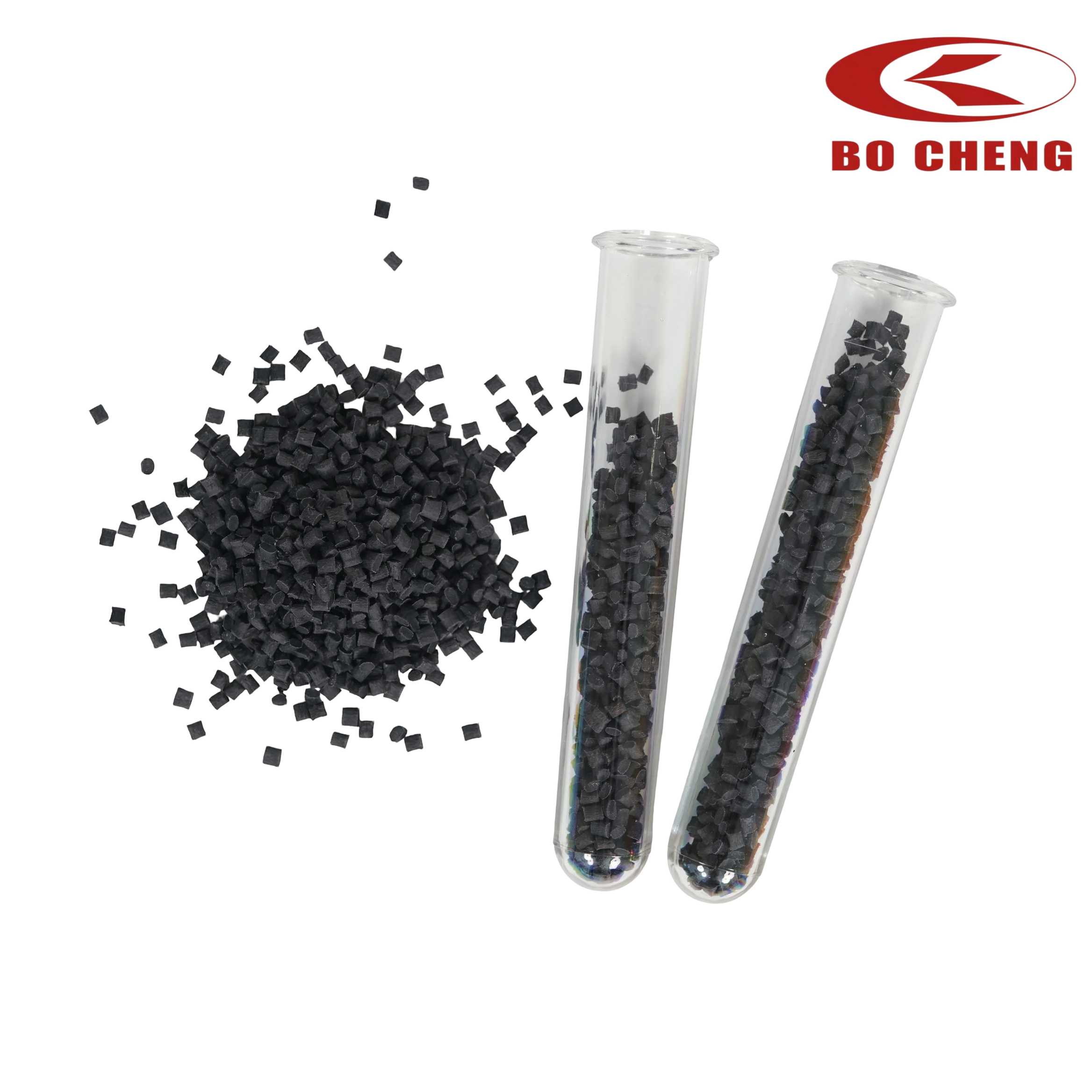
Selecting between carbon fiber and glass fiber reinforced nylon requires an objective balance of mechanical targets, weight constraints, and production budgets. While glass fiber remains the most economical choice for general structural parts, carbon fiber offers irreplaceable functional benefits in conductivity, wear resistance, and high specific strength.
By leveraging specialized formulations like PA612 CF30 and CF40, manufacturers achieve optimal performance tailored to harsh operational environments. Partnering with technical compounding specialists ensures long-term material consistency and engineering support.
To review technical data sheets, request compound samples, or evaluate material selection for custom applications, visit https://www.pa6-pa66.com/.